
Introduction

The Dock the Debris Program, part of our Rise Above Plastic Campaign (RAP), creates awareness and advocates for more environmentally friendly solutions for docks in harbours and marinas, as well as privately owned docks, with a specific focus on EPS (expanded polystyrene) pollution.
The Ongoing Issue of EPS pollution
Expanded polystyrene (EPS, also known as styrofoam) pollution from marine dock floats is an urgent, unaddressed issue impacting the Salish Sea.
Large pieces of EPS are toxic to fish and marine mammals if ingested, hazardous to boats and sea traffic, and contribute to the spread of invasive species.
EPS fragments of all sizes find their way to the shores of coastal communities across British Columbia. According to the outreach by the BC Ministry of Environment and Climate Change Solutions, 84% of British Columbians are “‘very concerned’ about plastic pollution.”
EPS is the material of choice for most dock flotation in British Columbia. The composition of EPS is, however, fragile and breaks easily causing pollution when exposed to the harsh conditions common to coastal marine waters.
The coast of British Columbia has had ongoing beach cleanups for decades, and the cost for volunteer shoreline cleanup can exceed $2,000 per kilometre. Cleaning up the 25,000 kilometres of shoreline in British Columbia quickly becomes a $50 million annual effort, not including compensation for labour.
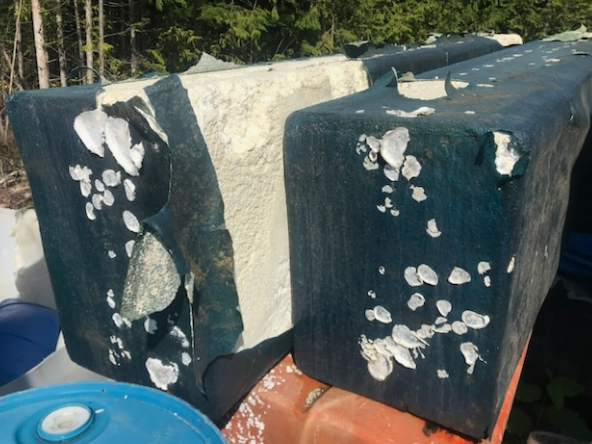
Washed-up encased EPS billets found during a beach cleanup along the coast of British Columbia.
Enencapsulated and encapsulated floats
The majority of fragmented EPS originates from both unencapsulated and encapsulated floats located in nearshore or foreshore waters of BC. Clean up crews find that both types of EPS floats cause pollution, and the encapsulated floats are even more difficult to remove from the environment as they fill up with sand, debris and water.
South Vancouver Island
Dock owners on South Vancouver Island often replace unencapsulated EPS billets with encapsulated EPS billets. Our surveys held in local marinas and harbours show a type of replacement that is wrapped with a thin layer of polystyrene of less than 1/32 of an inch. We often find that these floats get small rips, dents and gaps because the polystyrene wrapping does not appear to be thick enough. The billets are attached with screws underneath the docks, protruding the wrapping and potentially exposing EPS.
Washington State has set the standard to prevent this kind of pollution with a State-wide ruling on Styrofoam pollution by demanding a minimum of more than 1/8 of an inch encasing around EPS billets, to protect their waters from styrofoam pollution.
Take action to end EPS Marine Pollution in British Columbia
British Columbia has a clear opportunity to stop this pollution at the source. Durable, technically advanced air-filled flotation systems already exist and are widely used, proving that safer alternatives are available and effective. By writing to British Columbia’s Minister of Water, Land and Resource Stewardship, you’re calling for a province-wide prohibition on polystyrene in aquatic infrastructure, a practical, preventative solution that protects our waters before pollution occurs.
TAKE ACTION
Sign a letter to British Columbia’s Minister of Water, Land and Resource Stewardship to call for a province-wide prohibition on polystyrene in aquatic infrastructure, a practical, preventative solution that protects our waters before pollution occurs.
Project Lead
Zoë Melanie Minnaard
rap@svi.surfriderfoundation.ca
-
DescrThe Dock the Debris project was launched in November 2020 to reduce and address the impacts of single-use plastics, marine debris, micro and macro plastics in Marina environments using Seabin technology and data collection research. Even with waste collection and management systems in place, debris still ends up in marina waters through human activity in the harbour, the breaking down of non-encapsulated floating docks, and upstream sources.
The Dock the Debris Program donated several Seabins in concentrated debris areas to the North Saanich Marina and the Victoria Harbour Authority. Dock the Debris teamed up with student researchers from the University of Victoria to conduct bin audits every season to analyze and quantify the litter captured by the Seabins. This scientific research helped us create more awareness and education regarding localized plastic pollution on both a regional and national level and, with policy relevance, helping us move towards a circular economy.
-
2020 – SFSVI’s Dock the Debris Project is born. Fall 2019 Blue Friday businesses raise $15,192.89 from all profits on their Black Friday sales and donate to Dock The Debris.
SFSVI installed two Seabins in North Saanich Marina, one located in the North Dock wing and the other in the Blue Heron wing. Fall 2020, Blue Friday businesses raise $11,613.74 to help SFSVI install additional Seabins in the North Saanich Marina!
2021 – SFVI and University of Victoria research students begin to conduct quantitative research on two of the three Seabins to start characterizing and quantifying the marine debris collected.
2023 - Dock the Debris completes a Survey on EPS pollution in all major Marinas and Harbours on the Saanich Peninsula and in the Victoria area. SFSVI Donates the Seabins to the Greater Victoria Harbour Authority, to be installed in the Inner Harbour. Greater Victoria Harbour Authority installs Seabins in the Inner Harbour.
2023 - Swim Fish Drink Foundation donates their BC Seabins to the Dock the Debris Program
2024 - Dock the Debris completes Survey of EPS pollution in Marinas west of City Victoria.
-
Share your knowledge on EPS pollution to those who you think should know.
If you have the time and energy and/or ideas then please join our team to address issues related to pollution coming from privately owned docks, marinas and harbours.
-
A new Private Member’s Bill: Bill C-244, the Clean Coasts Act has been introduced in Parliament to strengthen Canada’s marine pollution laws. The bill would help end plastic pollution from docks and aquaculture sites, and hold owners accountable for wrecked and abandoned vessels.
Take action: Write to your Member of Parliament and urge them to support Bill C-244. Together, we can protect Canada’s waterways and coastlines from pollution.
Please follow this link to our Surfrider Canada Campaign: Free Foam Waters Campaign and sign the petition to support the Bill C-244: https://surfrider.ca/foamfreewaters